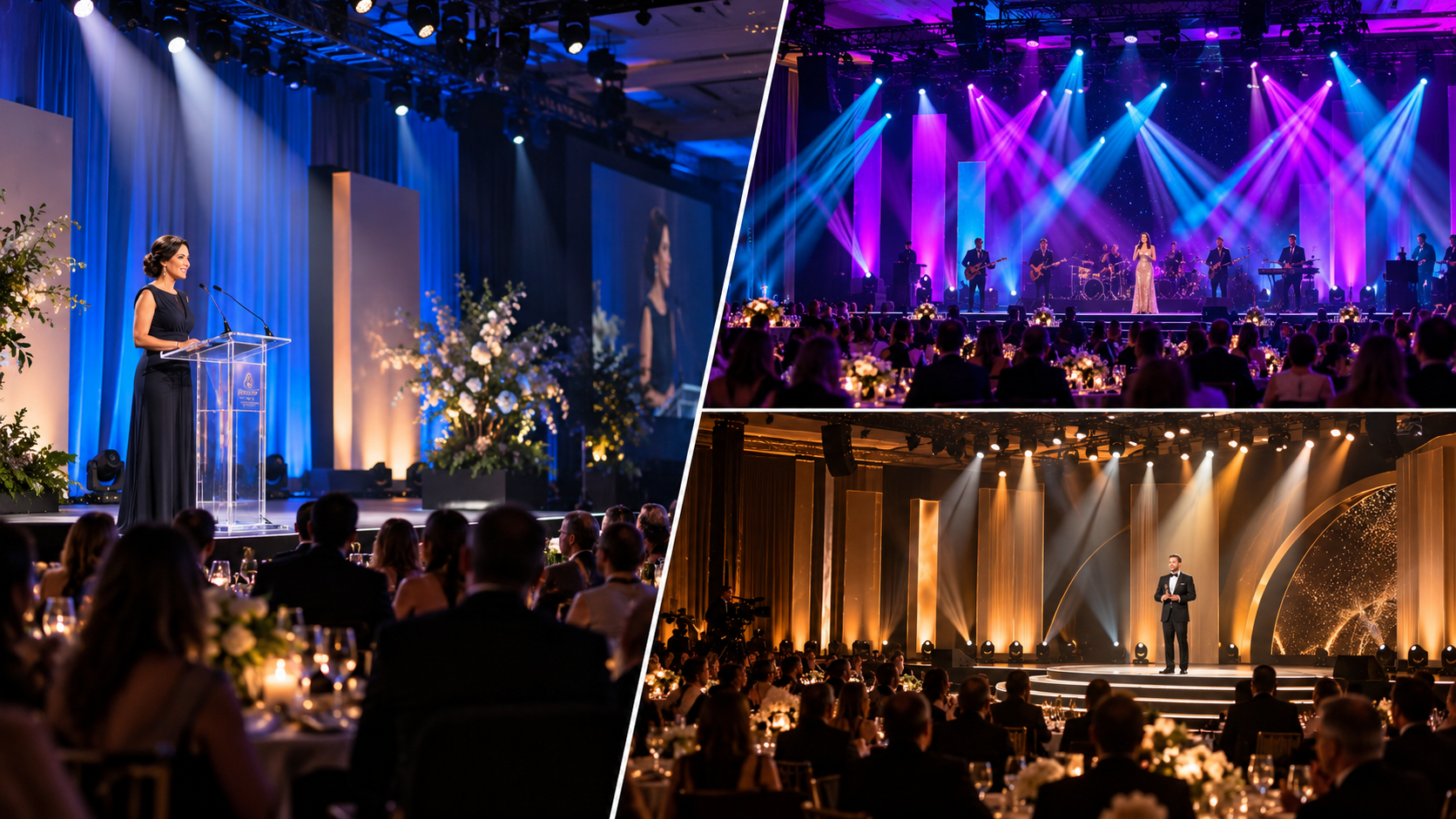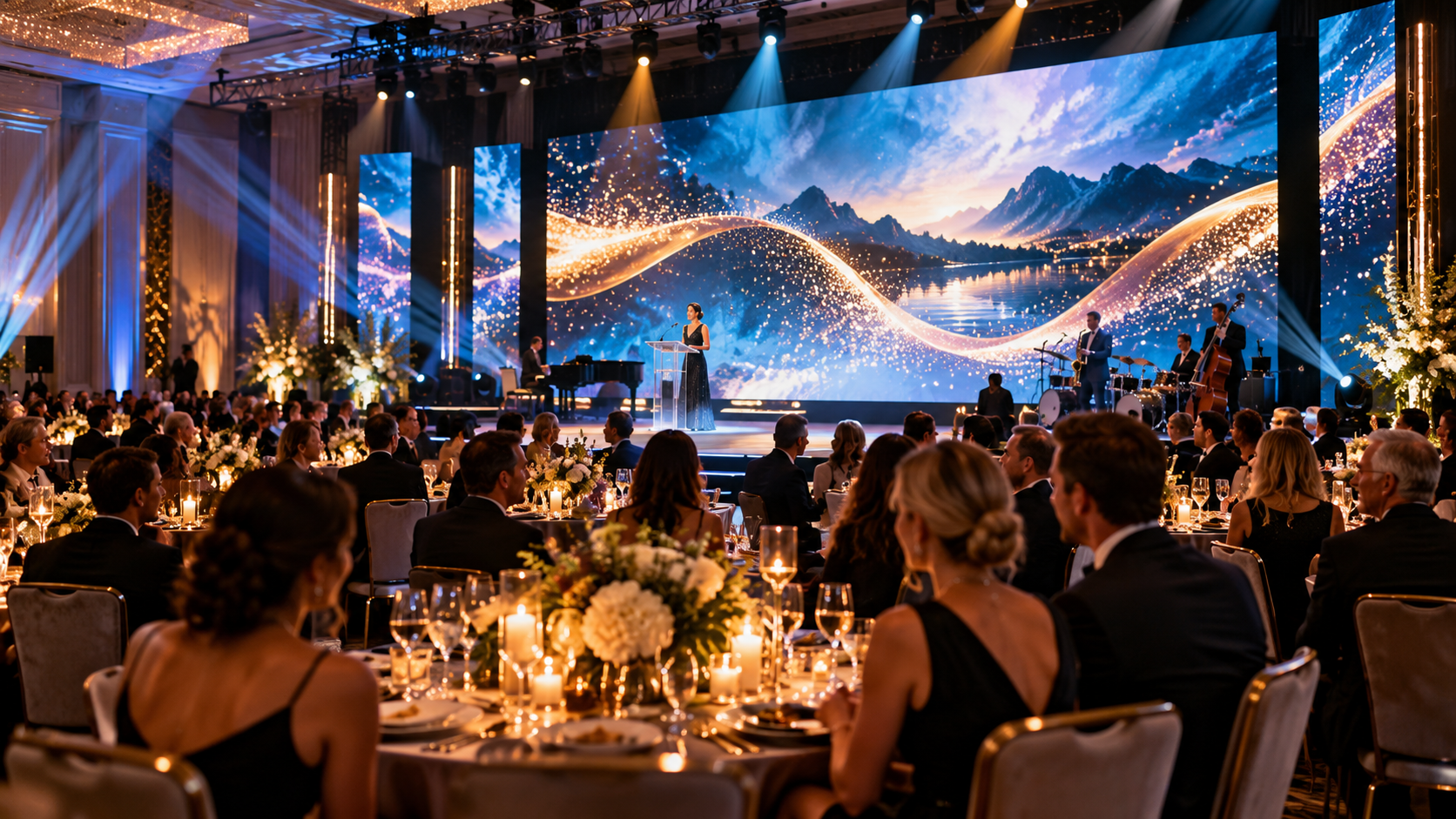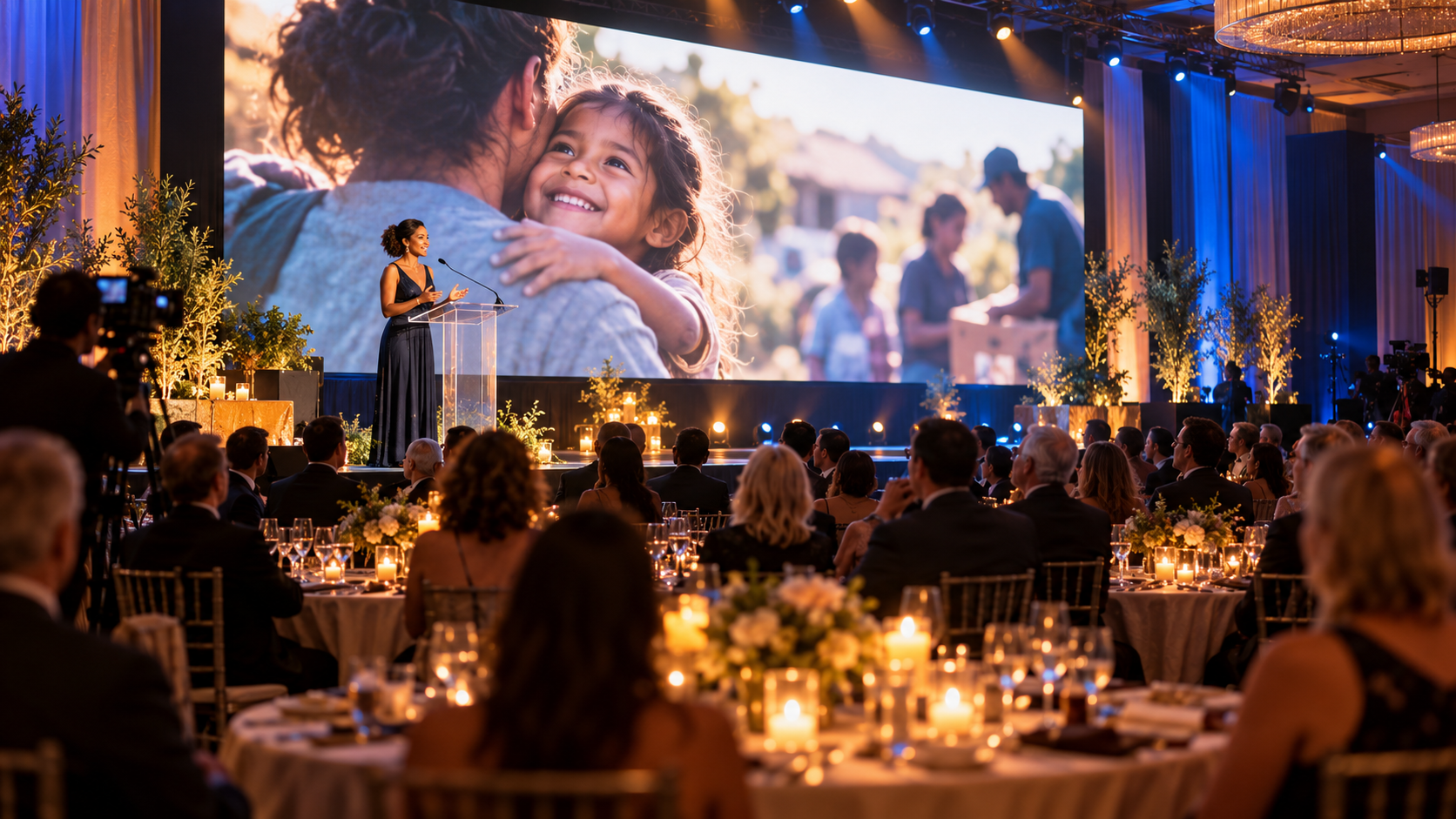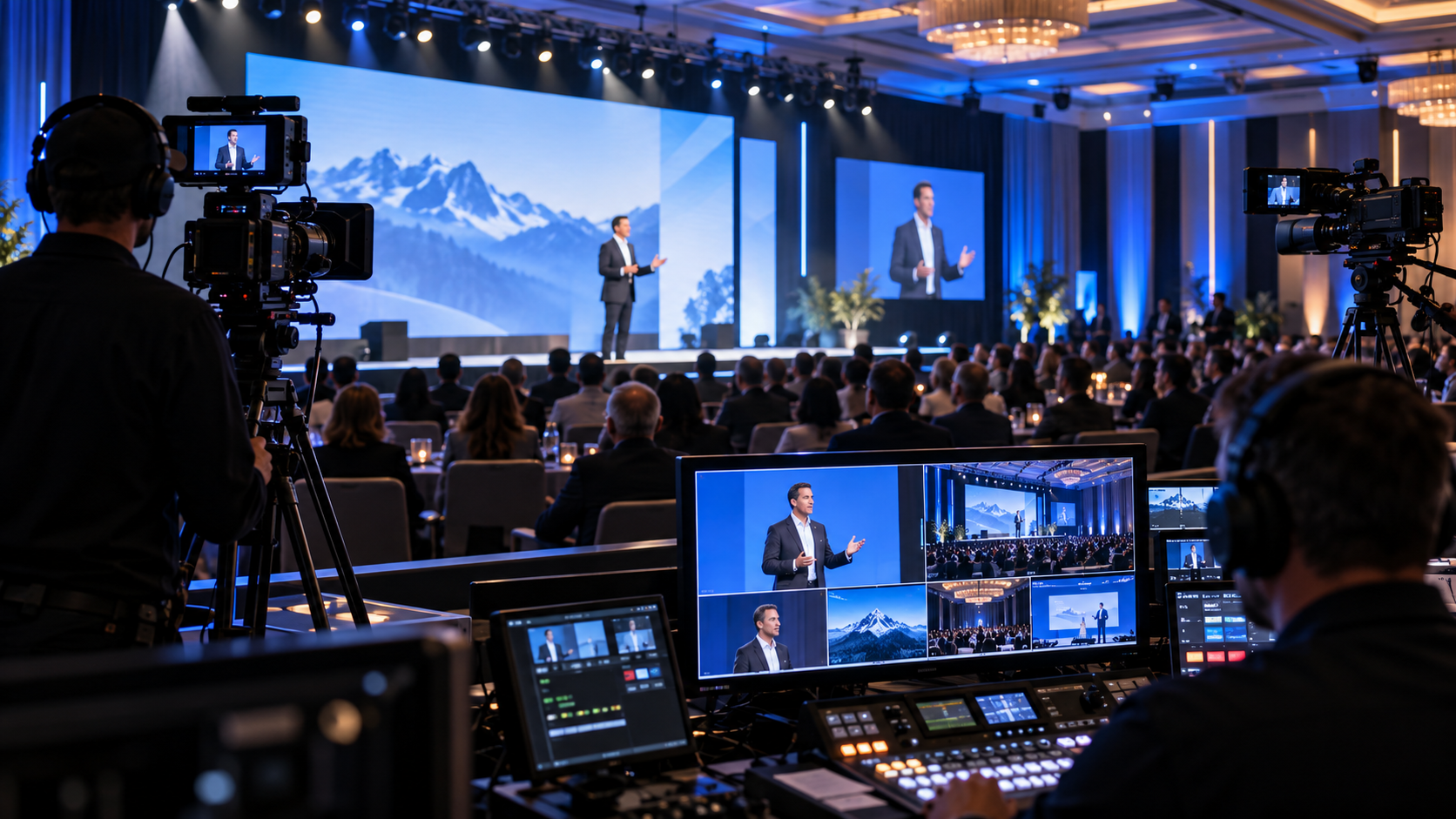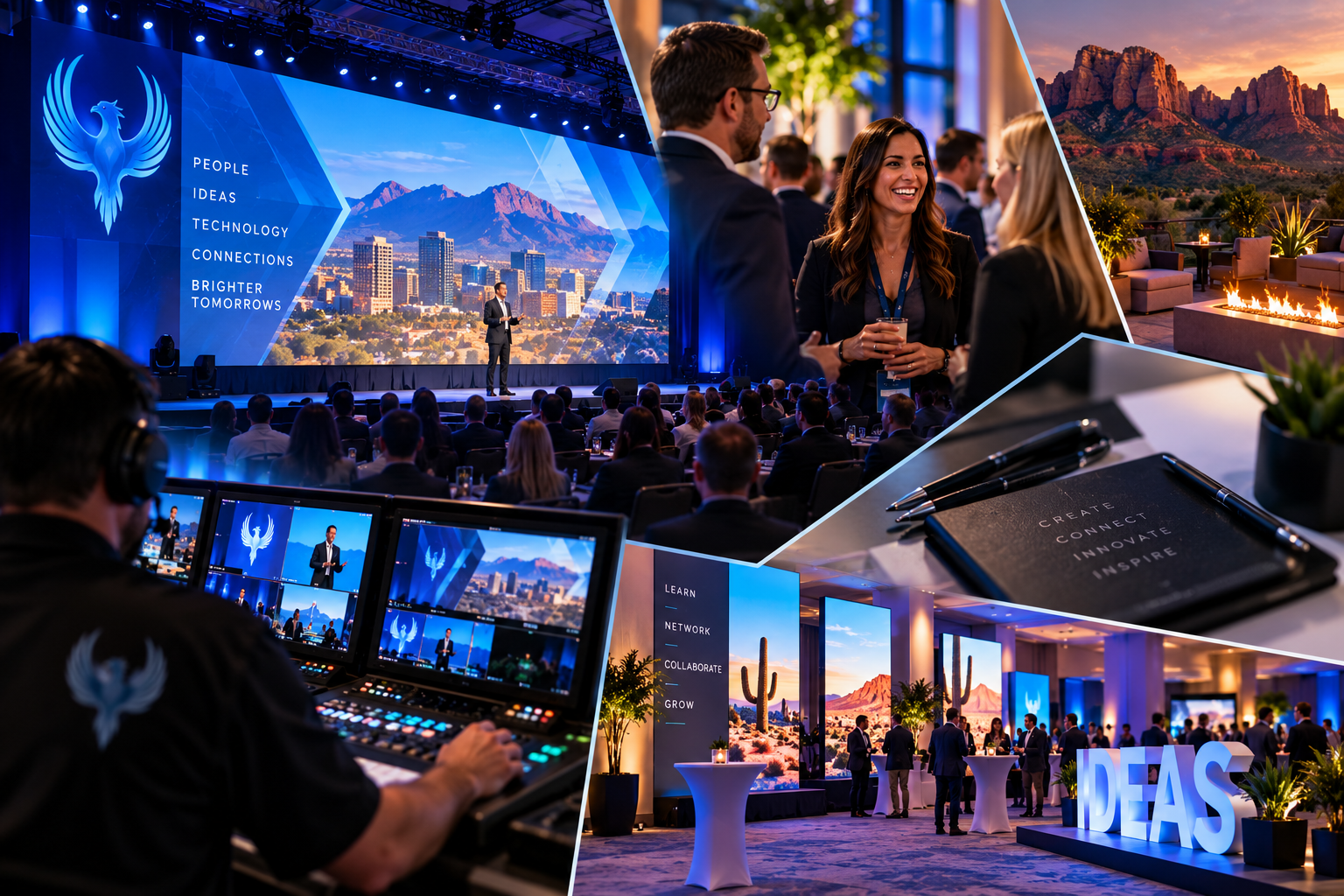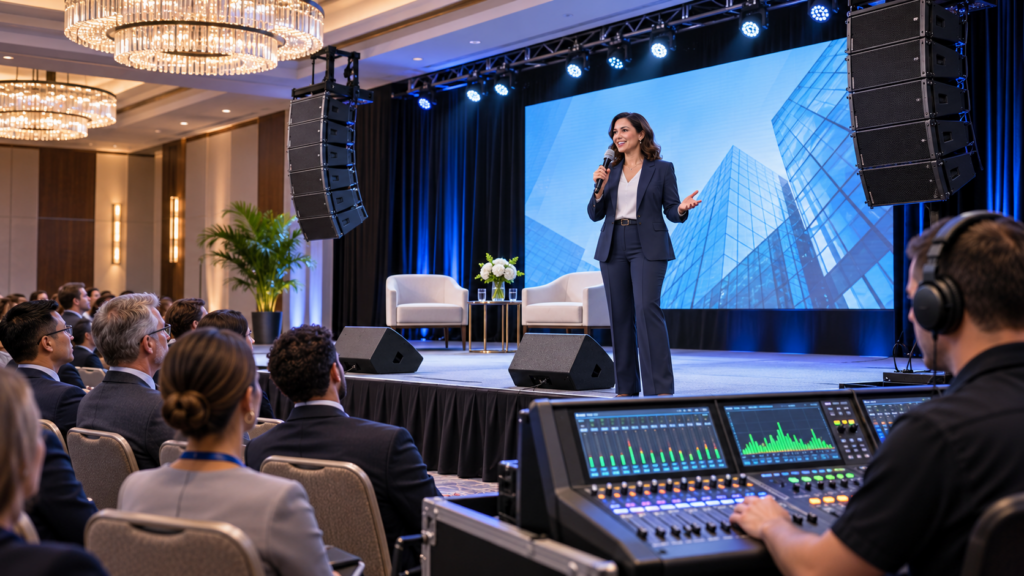
When companies plan a major conference, leadership meeting, product launch, sales kickoff, awards program, or corporate presentation, the most visible technology often gets the most attention over audio.
The giant LED wall. The cinematic opening video. The animated graphics. The multi-camera production. The beautifully designed presentation.
All of these things can make an event look incredible.
But there is one technical element that can undermine every one of them if it fails: Audio.
A presentation can survive a slightly imperfect camera angle. It can survive a momentary drop in video resolution. It can even continue if a display temporarily goes dark.
But if the audience cannot understand what the CEO, keynote speaker, panelist, or presenter is saying, the communication itself begins to break down.
For speech-driven corporate events, that makes professional audio arguably the most important part of the entire audiovisual system.
Your Audience Came to Hear the Audio Message
Imagine attending a corporate leadership conference. The stage looks fantastic.
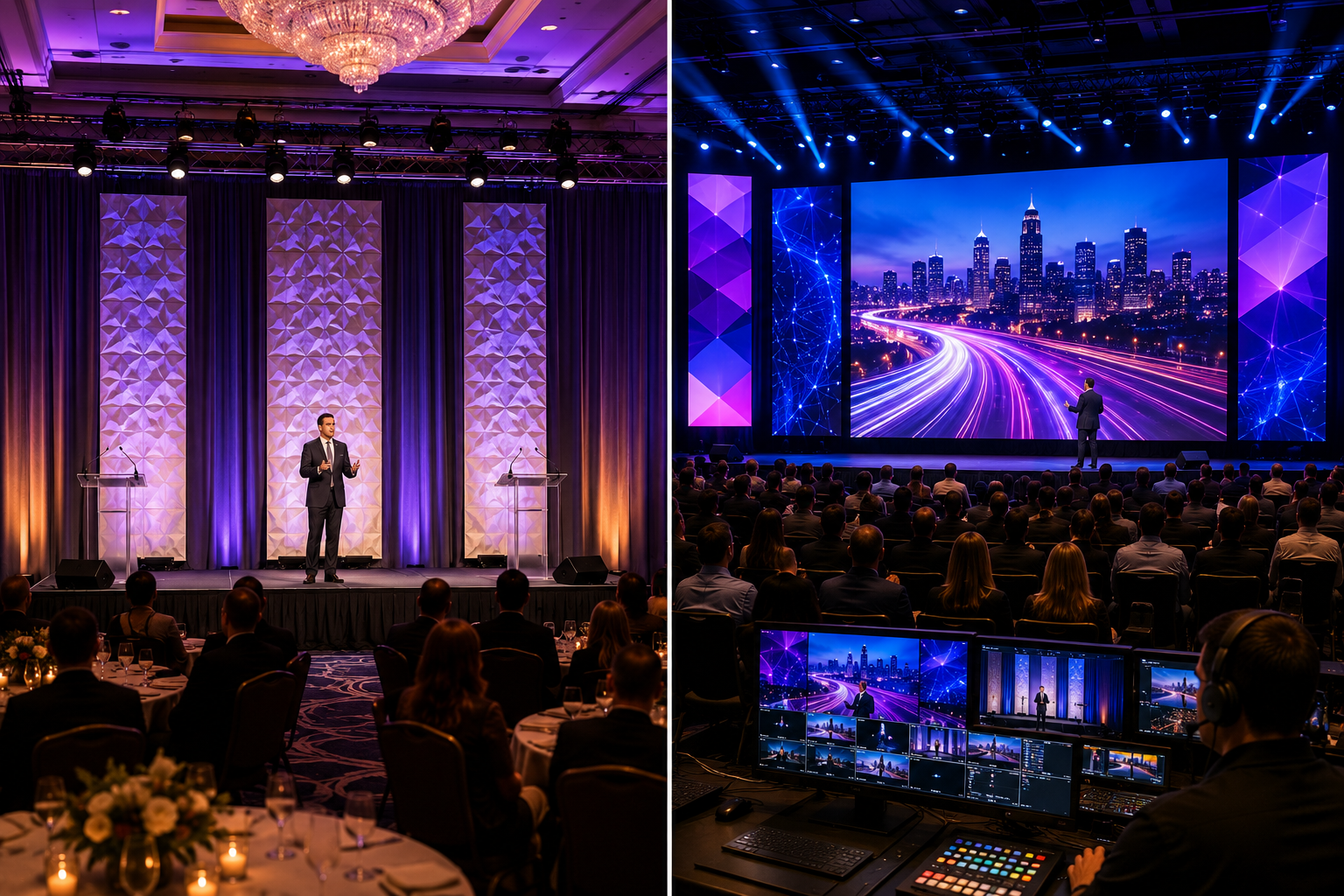
A massive LED wall stretches behind the presenter. The lighting is elegant. Multiple cameras capture the keynote from different angles.
Then the CEO begins speaking. The microphone sounds distant. There is noticeable echo. People near the back of the ballroom struggle to understand certain words. A wireless microphone begins cutting in and out.
Suddenly, none of the beautiful visuals matter very much.
Shure’s guidance for corporate sound makes an important distinction: music reproduction is often about fidelity, while spoken-word audio is primarily about intelligibility—the listener’s ability to understand the speaker easily. In corporate environments, Shure describes speech intelligibility as mission-critical because meetings and conferences become less effective when participants cannot understand the person speaking. [Shure]
Sennheiser makes a similar point in its guidance for conference systems. As rooms become larger, sound reinforcement becomes increasingly important because a person speaking at one end of a conference room can be difficult to understand at the other. [Sennheiser]
The goal isn’t simply to make the microphone louder. The goal is to make the message clear.
Poor Audio Can Actually Change How People Judge the Speaker
This is where things get particularly interesting for corporate event planners. Poor sound doesn’t merely annoy an audience. Research suggests it can influence how people perceive the person speaking.
Researchers from the University of Southern California and Australian National University studied how audio quality affected perceptions of recorded conference presentations and science interviews.
In one experiment, 97 participants viewed conference-talk videos in which researchers intentionally manipulated the sound quality.
When the audio was harder to hear, participants rated the presentation more negatively. They also perceived the speaker as less intelligent and less likable, and considered the research being presented less important. Researchers concluded that making information harder to process could also make it seem less credible. [USC Today]
Think about what that means for a corporate event. Your CEO may have spent weeks preparing the presentation. Your keynote speaker may be one of the leading experts in the industry. Your sales leadership team may be unveiling the company’s strategy for the next year.
Yet poor audio can unintentionally affect how the audience perceives the person delivering that information. That is a much bigger problem than simply hearing a little microphone hiss.
Newer Research Shows the Effect Goes Even Further
A 2025 Yale-led study published in Proceedings of the National Academy of Sciences examined what researchers called auditory “disfluency” in videoconferencing.
The researchers found that thin or “tinny” sounding speech caused listeners to judge speakers less favorably across several areas, including intelligence, credibility, and hire-ability. [PNAS]
The speaker hadn’t changed. Their knowledge hadn’t changed. Their qualifications hadn’t changed.
The sound had changed.
That should be an important consideration for corporate organizations producing executive presentations, investor meetings, recruitment events, virtual conferences, leadership panels, and customer-facing broadcasts.
Your sound system isn’t simply carrying the speaker’s voice. It can influence how that voice is perceived.
Bad Audio Makes Your Audience Work Harder
Even when people technically understand the words, poor acoustics can make listening more difficult.
A 2022 study published in the Journal of Speech, Language, and Hearing Research examined how reverberation and distance affected listening effort in adults.
Researchers found that increased reverberation and greater listener-to-speaker distance worsened word recognition and increased both measured and perceived listening effort.
Another study examining noise, reverberation, and speech perception found that adverse acoustic conditions increased listening effort and could also reduce comprehension. [PubMed]
This matters tremendously during a corporate conference. Your attendees may already be processing:
- presentation slides
- financial data
- new products
- training information
- speaker transitions
- networking conversations
- hours of content
They shouldn’t also have to spend extra mental energy decoding what the presenter is saying. Professional audio should make listening feel effortless.
The Ballroom Itself Is Part of the Audio Sound System
One misconception about event audio is that hiring better speakers automatically produces better sound.
It isn’t that simple. The room matters too.
Large hotel ballrooms, convention halls, meeting rooms, warehouses, and other event spaces can contain reflective surfaces that increase reverberation. HVAC systems, audience noise, staging, room dimensions, ceiling height, and loudspeaker placement can all affect what attendees hear.
Shure notes that surfaces such as glass, concrete, and whiteboards can create reflections that reduce speech clarity, while ambient noise can further interfere with intelligibility. [Shure]
That is why professional corporate-event audio requires more than plugging two speakers into a mixer.
A production team needs to consider things like:
- Room size and shape
- Audience layout
- Speaker placement
- Microphone selection
- Presenter movement
- Number of panelists
- Stage position
- Background noise
- Room acoustics
- Signal routing
- Monitor requirements
- Recording or live-stream feeds
Sometimes one loudspeaker system is appropriate. Other times, distributed speakers or carefully designed coverage may produce a much better result.
The correct solution depends on the room and the event.
Microphone Selection Matters More Than Many Planners Realize
Not every presenter should automatically receive the same microphone.
A CEO delivering a keynote while walking across the stage may benefit from a wireless lavalier or headset.
A panel discussion may require individual microphones for several participants. Audience Q&A may require handheld wireless microphones. An awards podium might use a goose-neck microphone. A presenter who speaks quietly may need a different approach than an energetic speaker who projects naturally.
Microphone placement is also critical.
Shure’s current guide to audio systems for meetings and conferences emphasizes that even sophisticated digital processing cannot fully recover intelligibility that was already lost at the input stage. Proper microphone selection and placement help maximize the desired voice while reducing noise and reverberation. [Shure]
In simpler terms: If the microphone doesn’t capture the speaker properly, everything downstream starts with a disadvantage.
Great Audio Is Essential for Hybrid Events Too
The importance of professional audio becomes even greater when part of the audience isn’t physically in the room.
Microsoft Teams, for example, uses processing designed to reduce echo, suppress background noise, improve distorted speech, and reduce reverberation because these issues directly affect the remote meeting experience.
Zoom similarly evaluates meeting performance using specific audio-quality measures, including perceived quality, audio delay, network behavior, and objective speech-quality metrics. Its testing underscores that both audio and video degradation can frustrate participants and reduce meeting quality.
For hybrid corporate events, the production team therefore needs to think about two audiences.
The people sitting in the ballroom need clear sound. The people watching online also need a clean audio mix. A microphone that sounds acceptable through the room’s PA system isn’t automatically optimized for the live-stream.
Professional production allows those signals to be managed appropriately.
Audio Is Also an Accessibility Issue
Clear sound benefits everyone, but it can be especially important for attendees with hearing difficulties.
The National Institute on Deafness and Other Communication Disorders reports that approximately 15% of American adults—about 37.5 million people—report some trouble hearing.
Event accessibility may also involve assistive listening systems and captioning. The U.S. Department of Justice’s ADA standards include requirements for assistive listening systems in qualifying assembly areas where audible communication is integral and amplification is provided. [NIDCD]
Corporate planners should therefore discuss accessibility requirements with their venue and production partners early rather than treating them as a last-minute addition.
A presentation cannot be truly successful if portions of the audience cannot access the message.
So Does Video Not Matter?
Of course it does. At Phoenix Technology Audio Visual, video is a major part of what we do.
LED walls can transform stages. Professional cameras help attendees see presenters clearly. Presentation graphics reinforce important information. Videos tell stories. Live-streams extend events beyond the venue. Lighting and scenic design can completely change how a corporate event feels.
But video and audio don’t have equal jobs.
Video often helps the audience see and experience the message. Audio frequently carries the message itself. If the LED wall briefly loses an animation, the speaker can continue talking. If the audience loses the speaker’s voice, the presentation itself effectively stops.
That’s why strong corporate event production needs both—but audio deserves attention from the beginning.
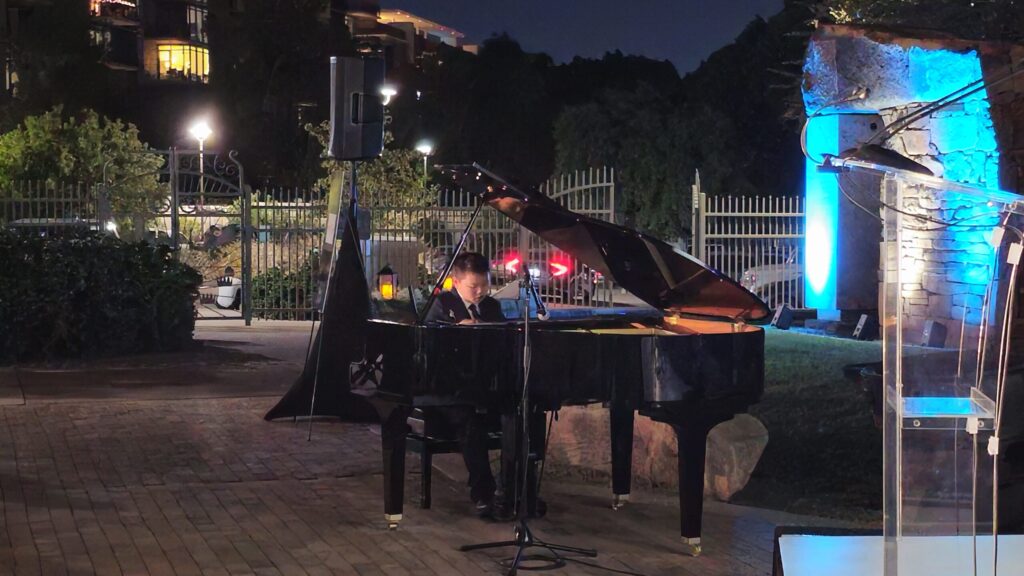
Let Phoenix Technology Audio Visual Make Sure Every Word Is Heard
Phoenix Technology Audio Visual provides professional audio solutions designed to help every word reach the audience clearly, including microphones, loudspeakers, sound reinforcement, mixing, and on-site technical operation. Our broader production services include video, LED walls, lighting, live-streaming, multi-camera production, content support, and complete live-event production.
Whether you’re planning a corporate conference in Phoenix or Scottsdale, an executive meeting in Tucson, a leadership retreat in Sedona or Prescott, or an event elsewhere in Arizona and beyond, involve your AV team early.
Tell them:
- How many people are attending?
- How large is the room?
- How many speakers and panelists will appear?
- Will presenters move around?
- Will there be audience Q&A?
- Will the event be recorded or live-streamed?
- Are there breakout rooms?
- Are accessibility services required?
Those answers help a professional production team design the right system rather than simply deliver equipment.
Because your audience may forgive an imperfect camera angle. They may forgive a graphic that arrives one second late. They may even forgive a video that doesn’t look quite as cinematic as planned.
But when your company’s most important message is being delivered from the stage, there is one thing every attendee needs: They need to hear it.
Make sure they do.
Phoenix Technology Audio Visual
High Tech, Low Footprint Solutions!
See our past work [HERE] and start planning your next corporate event. Be sure to give us a follow on FACEBOOK and LINKEDIN for more awesome content and updates!