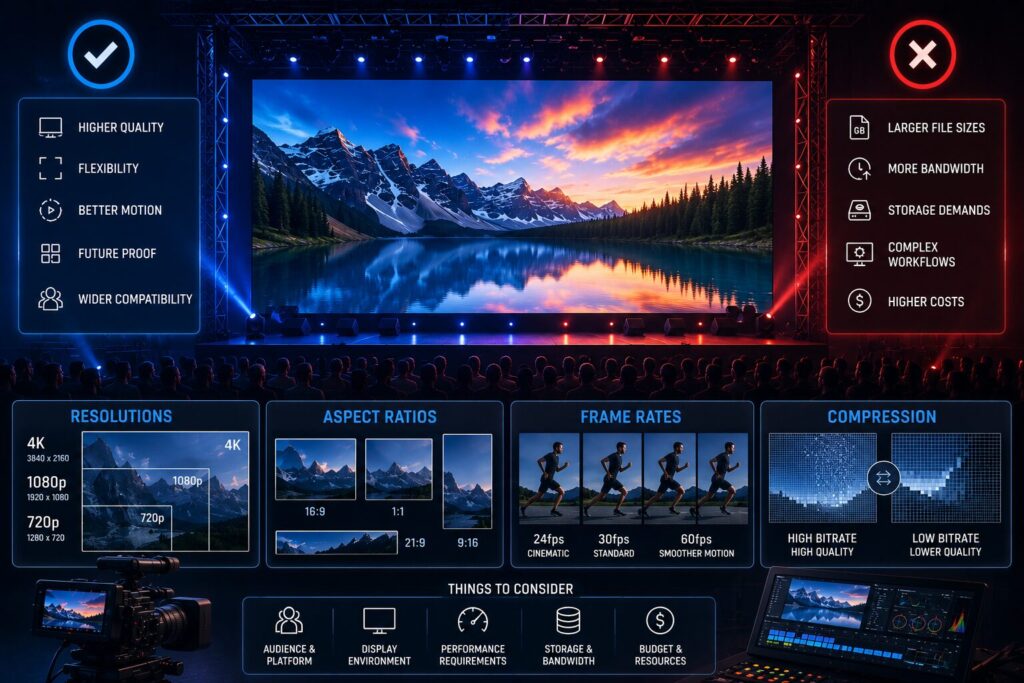
In the world of live events, video is one of the most powerful tools for creating impact, telling a story, and keeping an audience engaged. Whether it’s an LED wall backdrop for a keynote speaker, a livestream feed for virtual attendees, or pre-produced highlight reels for a gala, the video formats you choose play a major role in how your message is delivered and perceived.
At Phoenix Technology Audio Visual, we’ve seen firsthand how the right (or wrong) format can elevate or limit an event. Understanding the strengths and weaknesses of each type of video format can help you make informed decisions for your next production.
1. Standard Definition (SD) Video Formats
What It Is:
The once-standard 480p resolution that was the norm before HD became widely adopted. While it’s rarely used for primary displays anymore, it still appears in older content archives or budget-limited setups.
Pros:
- Low bandwidth requirements: Works well for smaller livestreams where internet speeds are limited.
- Smaller file sizes: Faster upload, download, and storage.
- Cost-effective: Some older systems and gear can only handle SD, keeping rental or setup costs low.
Cons:
- Visibly lower quality: On modern screens and LED walls, SD looks pixelated and dated.
- Poor readability: Text, graphics, and fine details are harder to see.
- Limited audience impact: In a world accustomed to HD and 4K, SD doesn’t impress.
Best For:
Archival playback, low-speed internet livestreams, or extremely budget-conscious internal meetings.
2. High Definition (HD) Video Formats
What It Is:
The most widely used format today, generally at 720p or 1080p resolution. HD has become the “baseline” for professional events.
Pros:
- Sharp visuals: Looks crisp on most standard screens and projectors.
- Widely compatible: Works with nearly all modern playback systems and display gear.
- Balanced file sizes: Better quality than SD without the massive file size of 4K.
Cons:
- Not future-proof: As more audiences get used to 4K and higher, HD will eventually feel outdated.
- Scaling limitations: On very large LED walls, HD may need upscaling, which can soften image quality.
Best For:
Conferences, fundraisers, corporate presentations, and live performances where strong clarity is needed but ultra-high resolution isn’t critical.
3. Ultra High Definition (4K) Video Formats
What It Is:
Four times the resolution of standard HD, offering exceptional detail and clarity. 4K is becoming increasingly popular for large-screen and LED wall applications.
Pros:
- Incredible clarity: Perfect for big-screen visuals, intricate designs, or content with fine text and graphics.
- Future-ready: 4K is steadily becoming the new standard.
- More creative flexibility: Allows for cropping, zooming, and scaling without losing quality.
Cons:
- Higher file sizes: Requires more storage and longer render/export times.
- Bandwidth-heavy: Demands stronger internet speeds for smooth livestreaming.
- More processing power: Needs capable playback systems and equipment.
Best For:
Large-scale LED wall displays, high-profile events, cinematic pre-show content, and corporate product launches where detail matters.
4. Livestream-Optimized Video (Adaptive Video Formats)
What It Is:
Video formatted to automatically adjust resolution based on viewer bandwidth, such as adaptive bitrate streaming.
Pros:
- Universal accessibility: Ensures viewers with slower internet can still watch without constant buffering.
- Efficient delivery: Uses the optimal resolution for each viewer in real time.
- Ideal for hybrid events: Keeps both in-person and remote audiences engaged.
Cons:
- Dependent on platform compatibility: Requires specific streaming software or services.
- Possible quality drops: Viewers on slow connections may only see lower-resolution feeds.
Best For:
Virtual conferences, hybrid corporate events, remote training sessions, and fundraisers with global audiences.
5. Aspect Ratio Considerations
Beyond resolution, aspect ratio (the shape of your video frame) plays a crucial role.
- 16:9 (Widescreen): The modern standard for most presentations, broadcasts, and livestreams.
- 4:3 (Standard): Still used in older projectors or archival content but less visually appealing for modern screens.
- Custom Ratios: For ultra-wide LED walls or vertical digital signage, content may need to be reformatted to avoid black bars or cropping.
Pros of Correct Ratios: Content fills the screen properly, maintains visual balance, and avoids distortion.
Cons of Wrong Ratios: Stretching, cropping, or pillar-boxing can make professional productions look amateur.
6. Frame Rate and Compression
Frame Rate: Higher frame rates (60fps) make motion smoother for live events or sports content, while lower rates (24–30fps) give a more cinematic feel.
Compression: Reduces file sizes but can introduce artifacts if overly aggressive — think blurry backgrounds or blocky movement.
Pros of Higher Frame Rates: Crisp motion, great for fast-paced performances.
Cons: Requires more bandwidth and processing power.
7. Matching Format to the Event
The biggest mistake in choosing a video format is thinking “one size fits all.” The ideal format depends on your event’s type, audience, venue, and content style.
For example:
- Corporate Conference: HD or 4K for presentations with sharp slides and branding.
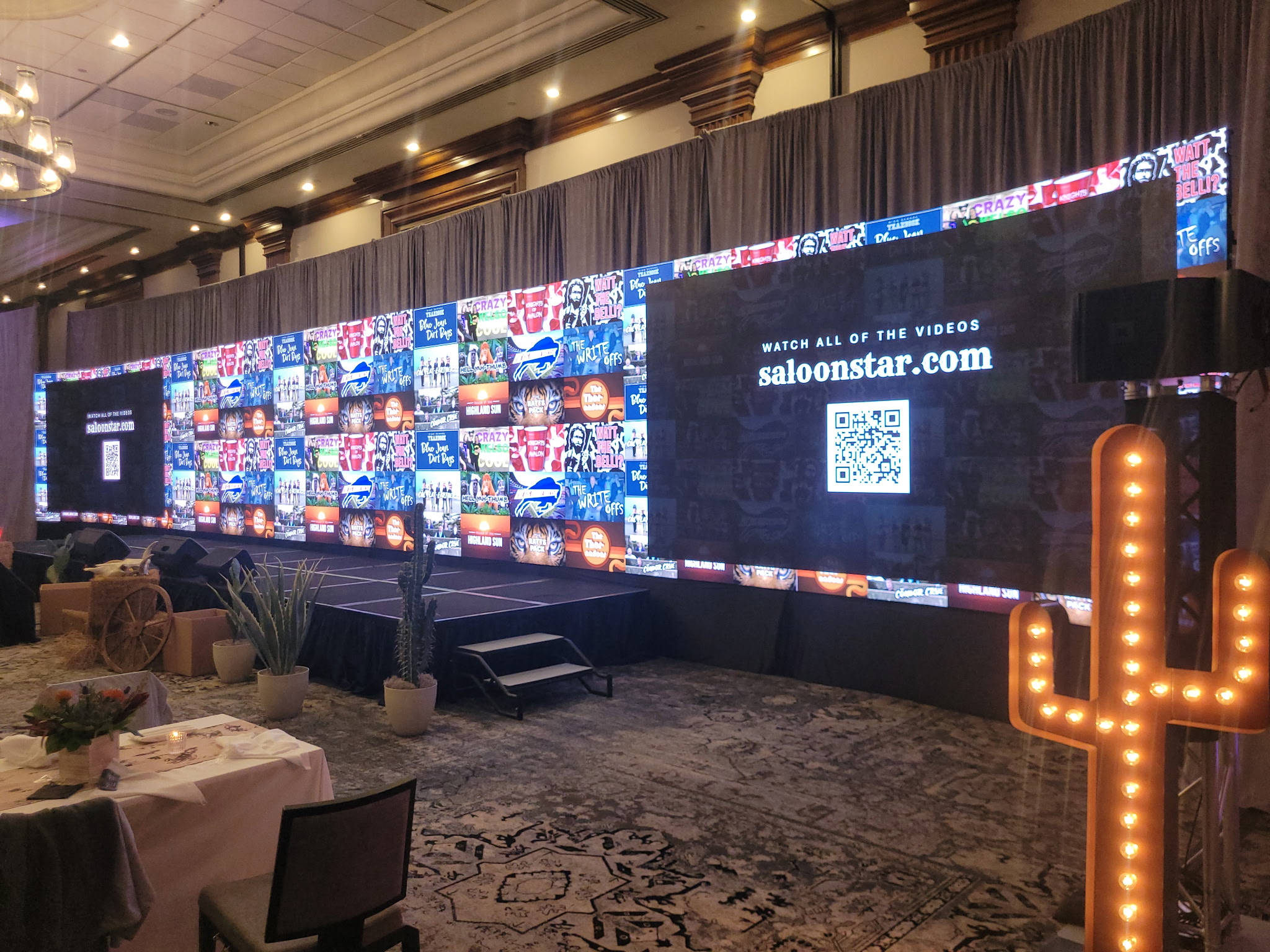
- Gala with LED Wall: 4K for vibrant, immersive visuals.
- Hybrid Fundraiser: Adaptive streaming to reach donors worldwide.
- Trade Show Booth Loop: HD with custom aspect ratios for vertical or ultra-wide displays.
The Phoenix Technology Audio Visual Advantage
Choosing the right video format isn’t just a technical decision — it’s a strategic one. At Phoenix Technology Audio Visual, we assess your event’s goals, venue specifications, and audience expectations to recommend and deliver the perfect format.
From content creation to live switching and playback, we handle every technical detail, so your message is as clear and captivating as possible. Whether it’s a dazzling 4K LED wall sequence, a crisp HD livestream, or a custom-formatted display for a unique stage design, we make sure your video works for your event, not against it.
When the right video format meets professional production, your audience doesn’t just watch — they remember. CONTACT US today for a free consultation & Quote, and be sure to check out more amazing content on our FACEBOOK page!